
In-ear IH, occlusion and acoustic leak
In-ear IH technology captures biosignals as fluctuations in pressure inside the ear canal, measured against a reference like ambient atmospheric pressure. These biosignals are primarily in the infrasonic range (0–20 Hz), frequencies below the audible spectrum (20–20,000 Hz). This low-frequency range, often less susceptible to ambient noise, contains valuable physiological information.
The IH earbud, with an in-ear placement design, not only plays audio but also detects biosignals in the infrasonic range. Each IH earbud includes a microphone for detecting pressure changes, as shown in Fig. 7. After applying proprietary algorithms to correct for instrumental effects and frequency response associated with the earbud placement in the ear canals51, the device response function is flat in frequency down to fractions of Hz, with the manufactured microphone sensitivity of −37 ± 1 dB and device tolerances within 6 dB at 1 Hz. Accurate detection relies on a seal between the ear tip and the ear canal wall, which introduces the occlusion effect: by blocking the ear canal, it creates a closed acoustic cavity that significantly amplifies internal sound pressure, particularly at low frequencies9.

The seal between a the ear tip and the canal wall is critical for achieving occlusion and minimizing acoustic leakage of infrasonic biosignals. The earbud consists of b a flexible silicone boot for comfort, mounted on c a front cap that houses d a MEMS microphone with sufficient sensitivity to detect infrasound. The rear section comprises e a speaker ring supporting f a speaker enclosed in g a back cap. Together, these components enable full-range audio playback. The system interfaces via h a cable connected to i a PCB board integrated with the clinical data acquisition setup. j Audio playback can occur in k the ear canal simultaneously with l biosignal monitoring, as infrasonic biosignals (<20 Hz) occupy a frequency range below that of audible sound (>20 Hz), allowing both functions to operate concurrently without interference. All components are off-the-shelf. Earbud design by MindMics, Inc.
This amplification effect can be explained using Boyle’s ideal gas law, where pressure and volume are inversely related. By sealing the ear canal even partly, the effective acoustic volume decreases sharply, resulting in a corresponding increase in dynamic acoustic pressure. This amplification can reach up to 40 dB, equating to a 1000-fold increase in amplitude, when the ear canal’s volume is reduced from an open 200 cc to a tightly sealed 2 cc. If the volume shrinks by half, it can boost biosignal strength by ~6 dB. This amplification is highly dependent on the level of the seal. Any acoustic leak—a small gap between the ear tip and the canal wall—compromises the seal, reducing the impedance and allowing low-frequency energy to escape. This leak decreases the dynamic pressure, lowering the occlusion effect and, therefore, the sensitivity of biosignal detection. Variations in earbud seals change the sensitivity of IH technology to detect biosignals across different frequencies, causing significant changes in both the amplitude and waveform shape, due to the frequency-dependent nature of impedance changes, which require proper instrumental corrections51.
Data collection protocol
The data sample used in this work was recorded in a clinical study at Scripps Health (ClinicalTrials.gov Identifier: NCT04636892; start date: Jan 5, 2021, end date: June 13, 2023, approved by Scripps Health Institutional Review Board) from 24 study subjects undergoing in-vivo CC for evaluation of the coronary artery disease (CAD). Among 5 groups of cardiovascular diseases enrolled in the study, the CAD study subjects exhibit aortic waveforms consistent with those of healthy individuals, providing good representation of the target population. The data collection protocol involved recording of simultaneous signals from MindMics earbuds and gold-standard cardiac monitoring devices: electrocardiogram (ECG), pulsed wave Doppler echocardiogram, and cardiac catheter. The goal of the study was to determine the accuracy and validate the IH technology for hemodynamic and cardiac measurements using gold-standard signals. Locally, the project was coordinated by 3 cardiologists and 2 clinical trial coordinators (CTC) at Anderson Medical Pavilion, Scripps Health, La Jolla, CA. Three areas were used for protocol activities, as depicted in Fig. 8. Upon arrival at the research center, study subjects were moved to a pre-op holding area where they were fitted with proper-size earbuds by a CTC on duty, the earbuds’ signal quality was checked and a written consent was signed by study subjects prior to the procedure. Study subjects also wore IH earbuds for 3–5 min while at rest to gather baseline data. A dedicated room was used for a limited transthoracic echocardiogram (TTE) procedure performed by a designated sonographer. The left heart catheterization (LHC) procedure was performed in a surgery suite, with authorized personnel access only. The MindMics team participated in and operated the data collection remotely, by means of a teleconferencing system for connecting to a local computer at Scripps. While the order of the execution of the TTE and LHC procedures depended on departmental workflow for that day, the study protocol ensured that both the TTE and LHC were completed within a 2.5-h window. Throughout both procedures, study subjects continued to wear the MindMics earbuds to collect continuous data.

Clinical setup for data collection using TTE, LHC, ECG, and IH.
In the TTE part of the protocol, ~25–45 Echo images per study subject were collected simultaneously with the IH waveforms, with the Echo views corresponding to: AP 5C-CW Doppler AoV; AP 5C-PW Doppler LVOT; AP 3C-CW Doppler AoV; AP 3C-PW Doppler LVOT; and PW Doppler MV inflow. Each view was captured 2–5 times while the subject was at rest or performed the resonant breathing exercise and the Valsalva maneuver.
During the LHC procedure study subjects were at rest in a supine position. For each study subject, ~10–40 min of joint IH, ECG, and CC data were recorded, corresponding to ~500–2400 cardiac cycles. The data collection protocol included data with the tip of the catheter positioned in the aorta, but data from the left ventricle, radial/brachial or femoral arteries, and optionally left and right coronary arteries were recorded as well, depending on the type of the CC procedure. To increase variations in cardiac events, a minute of data from the aorta was recorded while the study subject performed breathing exercises. All data were recorded with the sampling rate of 1 kHz. In the analysis, the ECG, CC, and echocardiogram data are used to validate cardiac features in the IH waveforms, while the CC data from the aorta provide reference BP values for BP modeling.
The clinical equipment necessary for echocardiography and catheterization measurements was provided by Scripps Health. Medtronic, Terumo, and Boston Scientific coronary catheters were used to invasively measure blood pressure during the catheterization procedure. The catheterization room was equipped with a GE TRAM system, which is a multi-parameter module that simultaneously records multi-lead ECG signals and up to 4 channels with invasive blood pressure. The analogue output of the GE TRAM system and the MindMics IH earbuds were synchronized and recorded using a Data Acquisition System (DAQ) and sent to the computer over a wired USB connection and further to a MindMics cloud infrastructure using secured communication protocol MQTT, where the data was stored for future analysis. Overall there were 4 setups of devices available for this clinical study, each including a laptop computer to run the DAQ system, a set of MindMics IH earbuds, a hardware board hosting DAQ system and necessary cabling. The WiFi router was used to send the data from a laptop to the MindMics cloud. The echocardiogram data were recorded separately to a local Nucleus database in a form of high-resolution images, from where they were copied to a MindMics storage repository in the cloud; the time synchronization with MindMics signals was performed offline.
Consenting subjects participated in the study for about 3–5 h, including breaks between the procedures. This study involved only one visit to the Scripps clinic. There were no known risks to study subjects associated with wearing the MindMics earbuds during the procedure. The simultaneous data collection of signals from earbuds and catheter during a regularly scheduled catheterization procedure had a negligible effect on the outcome of the latter. Verbal communication between the study subject and the clinical coordinator was possible during the entire procedure, including times when the study subject wore earbuds. The protection of the privacy of study subjects was ensured by anonymizing the data by the Scripps CTC. All the study subjects’ confidential information was removed from study reports before they were handed over to the MindMics team. The only available information included study subjects’ sex, age, race, height, weight, classification of cardiovascular disease and comorbidities.
Study population
Table 1 shows an overall demographics for the CAD subjects in the study (n = 24), together with comorbidities. From the recruited subjects, 6 were discarded from the current analysis, because of issues with recording reference signals from the GE Tram unit (1 subject), an insufficient quality of ECG signals (2 subjects), or an insufficient earbud fit in study subjects’ ears (3 subjects) that could not be resolved at the time of data collection when the catheter head was in the aorta, due to limited access to the procedure area. The characteristics of the subjects selected for the analysis (n = 18) is as follows (also listed in Table 1): the age in the range between 49 and 85 (average 67) years, height between 155 and 188 (average of 173) cm, weight between 60 and 133 (average of 89) kg, 28% females. The fraction of females is comparable to the number observed in all cath procedures at Scripps (34%), which is similar for all Scripps hospitals. 10 subjects had obstructive CAD confirmed during the procedure.
Data preparation for analysis
Figure 9 shows a typical structure of the data collected during the CC procedure for one of the study subjects as an example. The top two plots present IH data collected with the left and the right earbuds, while the bottom plot displays blood pressure waveforms recorded with the catheter at different arterial and heart locations: the radial (yellow) and brachial (gold) arteries, the aorta (blue), the heart’s left ventricle (red), and the coronary arteries (green area). The dark blue region corresponds to a minute of breathing exercises performed by the subject while the catheter head was in the aorta. Regions with very low pressure values correspond to the catheter’s transitioning zones. The ECG signals are not shown in the figure. Only data with the catheter head in the aorta are selected for the blood pressure analysis, as described below.

Time series of the MindMics data from the a Left and b Right earbud, together with c the simultaneous catheter data for an exemplary study subject. Colors in the bottom plot indicate various catheter head locations (see text).
For Wiggers diagrams shown in Figs. 1, 2, and Supplementary Figs. 1, 2, sets of 15 consecutive ECG, IH, and CC waveforms were arbitrarily selected from regions when the catheter head was in the aorta. For BP modeling a data processing pipeline was introduced to create the so-called databanks with simultaneous IH and CC waveforms of individual cardiac cycles. In this pipeline: (i) the IH data were corrected for instrumental effects using proprietary algorithms, (ii) the IH and CC signals were merged into events corresponding to individual cardiac cycles, with a cardiac cycle defined as the time between two consecutive QRS peaks of the ECG, (iii) a data quality assessment of the catheter and IH signals was performed by requiring a good cross-correlation score between individual waveforms and good-signal templates, to remove waveforms with motions artifacts or instrumental noise (Fig. 10 for a 30-sec period in an exemplary study subject) (iv) accepted cardiac cycles were written into csv files (databanks) for further analysis. Figure 11 shows the number of cardiac cycles with simultaneous IH and catheter waveforms for each of the CAD study subjects after all selections. In total, there are 2171 cardiac cycles (data points) for BP modeling and timing analysis. In this sample, 14 (11) subjects have good signals recorded in the left (right) earbud, while 7 subjects have good signals simultaneously recorded in both earbuds.

Data quality assessment of a simultaneous catheter and MindMics IH time series for b left and c right earbuds data shown for each cardiac cycle in an exemplary 30-s study subject’s data. Cardiac cycles are defined by times between two consecutive QRS peaks of the ECG tracing (vertical lines). The distribution of signal quality, assessed using cross-correlation scores, is shown for d catheter waveforms, e IH signals from the left earbud, and f IH signals from the right earbud. Shaded regions indicate waveforms that passed the quality threshold.

Number of data points (cardiac cycles) for 18 study subjects who underwent cardiac catheterisation (CC) procedure for the evaluation of Coronary Artery Disease (CAD). Data points contain simultaneous in-ear IH and CC aortic pressure waveforms from individual heartbeats, defined by two consecutive QRS peaks of the ECG tracing. IH, CC, and ECG signals were recorded at a sampling rate of 1 kHz, and correspond to 30 s–6 min of data with the catheter head located in the aorta.
Comprehensive Wiggers diagrams and signal alignment
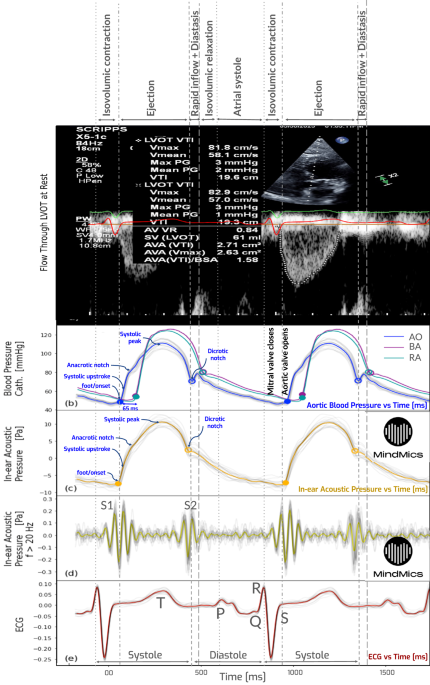
To evaluate the temporal relationships between cardiac events across multiple modalities, we generated a comprehensive set of Wiggers diagrams for study participants who underwent CC and had complete multimodal datasets comprising IH, 12-lead electrocardiography (ECG), echocardiography, and invasive aortic pressure recordings.
IH, aortic pressure, and ECG Lead II were recorded concurrently during CC at a sampling rate of 1 kHz. When available, peripheral pressure waveforms from the brachial, radial, and femoral arteries were also collected as the catheter advanced from the wrist or groin to the aorta. Although these peripheral traces were not acquired simultaneously with central signals, they serve to illustrate the progression of waveform morphology along the arterial tree. Doppler echocardiography of LVOT was typically obtained prior to catheterization and served as a reference for cycle timing.
To enable consistent temporal comparisons across modalities, cardiac cycles in both catheterization and IH signals were rescaled to match the inter-beat intervals (IBIs) extracted from the echocardiographic ECG trace. The signals were then aligned in time so that the QRS complexes in both echocardiogram and catheterization/IH ECGs were synchronized. Each Wiggers diagram panel includes, from top to bottom: LVOT Doppler flow, aortic pressure, IH waveform (corrected for instrument response), high-frequency IH (>20 Hz) revealing S1 and S2 sounds, and ECG Lead II. For each subject, 15 consecutive cardiac cycles were typically stacked to compute average waveforms. In cases where fewer high-quality consecutive segments were available across all modalities—such as in CAD11 and CAD17—nine and eleven cycles, respectively, were used. Across all panels, variability around the averaged waveforms was primarily due to respiratory modulation of cardiac signals.
Figure 11 summarizes the number of analyzable cardiac cycles per study subject and serves as a guide to the grouping strategy. Group I includes subjects with more than 90 cycles, enabling the development of individualized blood pressure models (CAD 02, 03, 04, 08, 10, 11, 14, 16, 17, 18, and 23). Subjects CAD 06 and CAD 23 are presented in Figs. 1 and 2, respectively. Group II includes those with 15–89 analyzable cycles, who were included in one model for all analyses but not used for individual modeling (CAD 01, 06, 07, 09, 13, 20, and 24). Subjects CAD 05, 12, 15, and 19 were excluded due to incomplete IH or aortic pressure data; CAD 21 and 22 were excluded due to missing ECG. Wiggers diagrams for all included subjects are annotated with aortic valve opening (AVO) and closing (AVC) timings and shown in Supplementary Figs. 1 and 2.
Features for BP prediction
Many studies have explored feature extraction from hemodynamic waveforms for BP modeling using machine learning25,26,27,52,53,54,55,56,57,58,59, particularly with peripheral PPG signals and reference SBP and DBP measurements from BP cuffs. Typically, a large set of potential features is generated based on various characteristic points of the waveform and their combinations. However, there is limited prior understanding of how these features correlate with BP dynamics. The challenge in determining feature-BP correlations arises because the BP signal from the cuff only provides the maximum and minimum values of the blood pressure waveform, which are also temporally separated.
The dataset used in this study includes full blood pressure waveforms recorded via a catheter positioned in the aorta, enabling a comparison of waveforms at different BP values to gain insights into how BP variations affect waveform shape. Figure 12 presents a comparison of normalized low- and high-BP waveforms, along with their first and second derivatives, from 4 exemplary study subjects. For each subject, the low- and high-BP waveforms were selected by minimizing and maximizing the product of SBP*DBP, respectively, as shown in the scatter plot.

Shape comparison of a normalized cardiac catheterization (CC) waveforms and their b first and c second derivatives corresponding to a high (red) and low (blue) BP in 4 exemplary subjects (rows 1–4). For each subject, waveforms are selected by minimizing and maximizing the product of SBP*DBP, as depicted by colored dots in the scatter plots (d). Differences in SBP, DBP, and PP = SBP-DBP between the two selected waveforms are indicated in the scatter plots as well. The duration of the cardiac cycle, also known as an interbeat interval (IBI), is inversely proportional to the subject’s heart rate, i.e. a shorter (longer) IBI corresponds to a higher (lower) HR.
Notable changes in the waveforms include the following: as BP increases, the waveforms become slightly narrower, with their maximum values delayed in time and the systolic portion shifted toward AVC. In the first derivative of the waveforms, the maximum at AVO remains largely unchanged with BP variations. However, the minimum at AVC becomes deeper, reflecting a more rapid decrease in pressure as the time approaches AVC at higher BP. It is also delayed. Similarly, changes in the second derivative occur mainly in the AVC region, with little variation observed in the AVO region.
Changes in heart rate (HR) appear to be a confounding factor when analyzing BP-induced changes in the waveform shape. However, HR variations primarily affect the diastolic phase of the cardiac cycle, causing its steeper exponential decline (Fig. 12a2, a4), while the duration of systole remains relatively unchanged.
The variations in waveform shape increase with BP changes. For examples shown in Fig. 12, the shape similarity expressed in terms of a cross correlation score decreases from 0.99 to 0.97 as the difference in SBP increases from 9 to 33 mmHg, respectively. When averaged over all subjects the score is 0.98 for the average SBP increase of 22 mmHg. We also calculated the cross correlation score for the difference in the waveform shape between the subjects at a fixed SBP. When averaged over all subjects pairs constructed from 9 (8) subjects that had measurement at SBP = 120 (130) ± 1 mmHg, the score is 0.95 (0.94). We conclude that in our sample, variations in the waveform shape due to BP changes are smaller than variations between subjects. This observation suggests that individualized BP prediction models, tailored to each subject, are likely to yield better performance than a single model applied across all subjects.
The waveform dynamics described above is used to create a list of features for BP prediction. These features, among others, include ratios of timings and normalized areas under the curve for selected parts of the cardiac cycle, the four leading moments of the systolic part, as well as amplitude ratios calculated at AVO and AVC times in the first and second derivatives of the waveforms. Other features in the list include waveform durations (interbeat intervals, IBIs) and the instantaneous heart rate, derived from these intervals. Finally, demographic variables such as sex, age, height, weight, body mass index (BMI), and body surface area (BSA) are incorporated when training a model for all subjects.
Machine learning model for BP prediction
Two approaches were used to predict SBP and DBP in the CC and IH data, based on features described in the previous section, extracted from individual cardiac-cycle waveforms after normalizing their amplitudes to the range of [0,1]: (i) we trained individual models for each of the study subjects, as well as (ii) one model for all the subjects. Features corresponding to demographic variables were used only in the latter case. Individual cardiac cycles were treated as a tabular rather than timeseries data, i.e. their time sequence was not used when training models. Reference SBP and DBP values were obtained from CC measurements, providing precision superior to that of traditional BP cuff devices (approx. 1 vs 5 mmHg, respectively).
For individual models, 12 subjects were used who had at least 1.5 min (≥ 90 cardiac cycles) of recorded data, to ensure a sufficient number of observations. Commonly used machine learning models from the scikit-learn library, such as SVM, KNN, LASSO and ElasticNet Regression, RandomForest and GradientBoosing ensemble-based models were trained to predict SBP and DBP. The results showed similar performance for the out-of-the-box models, slightly favoring the Gradient Boosting model (GBM) and LASSO Regression (LASSO) algorithms. In training and evaluating models for independent subjects, a 5-fold cross validation technique, with a 80/20% split for training/testing samples, was used. Table 2 shows model performance in terms of standard deviation between predicted and reference values of SBP and DBP for GBM and LASSO models, separately for CC and IH data, and for training and testing set. The numbers are evaluated after combining predictions from all 12 subjects. Given a limited sample size in this study, no full-scale hyperparameter tuning was performed for the GBM model, while the results for the LASSO model are shown with the regularization strength parameter changed from its default value α = 1 to 0.1, as it gave a better performance in a quick parameter scan. The IH-predicted vs CC-measured BP values from the Gradient Boosting model for individual subjects are compiled on a common plot in Fig. 4, separately for the CC (top) and IH (bottom) data and for SBP (left) and DBP (right). The Bland-Altman plots with the relationship of agreement for predicted and reference values of SBP and DBP are shown in Fig. 5, using similar figure layout.
When averaged over all 12 subjects, the standard deviation of the difference between predicted and reference BP values were 4.1 and 2.4 mmHg for CC and 5.8 and 3.7 mmHg for MindMics data, for SBP and DBP, respectively. A very good agreement with the reference for the CC sample demonstrates that BP information is encoded in the waveform shape.
For completeness, we also trained one model for all subjects, although the dataset comprising 18 subjects is too small for the model to sufficiently capture physiological differences in the general population. In this approach, the so-called Leave-One-Out technique was used to separate 18 subjects into training and testing samples. Namely, 18 trainings were performed, with each subject contributing 17 times to the training set and one time to the testing set. As mentioned earlier, subjects’ demographic variables were included in the list of input features. After aggregating the results of the GBM algorithm over all subjects, the standard deviation of the difference between predicted and reference values of SBP and DBP was 16.2 and 8.3 mmHg for CC data and 15.3 and 8.0 mmHg for IH data, respectively. Interestingly, when five data points from the test subjects were seeded to the training set, the model performance improved significantly, with the standard deviation of SBP and DBP prediction uncertainties reduced to 8.6 and 4.8 mmHg for CC data, and 9.8 and 5.7 mmHg for IH data, respectively. A discussion of these results is presented in the main text.
A preliminary feature importance analysis of the GBM and LASSO models revealed that although individual models differ in their set of most significant features, there is a common subgroup of features present in all subjects. These most frequent features include: the duration of the cardiac cycle (IBI) and its systole part (LVET), the area under the curve for the systole and the rapid ejection phase (from AVO to the waveform maximum) parts, moments of the systolic part of the waveform, the value of the normalized waveform at AVO and AVC, ratios of amplitudes of the first and second derivative at AVO and AVC, and the band power around AVO and AVC in various frequency bands from 0 to 50 Hz. For DBP, also the area under and diastolic part of the cardiac cycle and the slope of its exponential dependence are important for model prediction. A similar set of features appears to be important when training the multi-subject model, where, in addition, subjects’ age, height, and BMI are frequently used. A larger set of cardiac cycles for training individual models and a larger set of subjects for the multi-subject model are needed to conclude this analysis.
link