
Middle East Industrial Gases Market Summary
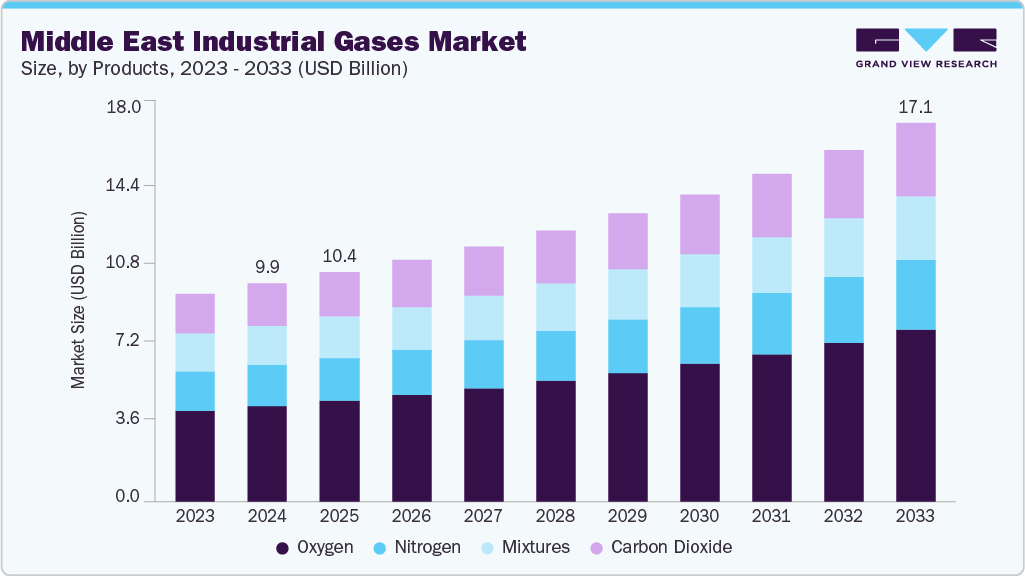
The Middle East industrial gases market size was estimated at USD 9,907.04 million in 2024 and is projected to reach USD 17,163.71 million by 2033, growing at a CAGR of 6.4% from 2025 to 2033. Growing industrialization, particularly in emerging economies, coupled with rising demand for energy-efficient and sustainable processes, has bolstered the market’s expansion.
Key Market Trends & Insights
- UAE dominated the Middle East industrial gases market with the largest revenue share of 27.06% in 2024.
- The UAE market is expected to grow at a significant CAGR of 6.9% from 2025 to 2033.
- By product, the oxygen industrial gases segment is expected to grow at the highest CAGR of 6.8% from 2025 to 2033 in terms of revenue.
- By application, the healthcare segment held the largest revenue share of 28.6% in 2024 in terms of value.
Market Size & Forecast
- 2024 Market Size: USD 9,907.04 Million
- 2033 Projected Market Size: USD 17,163.71 Million
- CAGR (2025-2033): 6.4%
The market is a critical enabler of manufacturing, processing, and healthcare industries worldwide, supplying gases such as oxygen, nitrogen, hydrogen, argon, and carbon dioxide. These gases are utilized across diverse applications, including steel production, chemical processing, electronics, food and beverage, and medical care. One of the key market drivers is the accelerating demand for cleaner energy and decarbonization initiatives, where hydrogen is gaining prominence as a fuel for fuel-cell vehicles and industrial energy transition. Likewise, rising consumption of nitrogen in the food and beverage industry for packaging and preservation, and oxygen in steelmaking and wastewater treatment, reinforces steady demand across established industries. The electronics sector also plays a vital role, with high-purity gases essential in semiconductor manufacturing, which is experiencing rapid growth due to digitization and electrification trends.
Another major driver shaping the market is technological innovation in gas production, storage, and distribution. Companies are investing in advanced air separation technologies, on-site generation systems, and renewable-powered electrolysis for green hydrogen, aligning with global sustainability goals. Moreover, the increasing adoption of industrial gases in healthcare facilities, metal fabrication, oil and gas, and specialty applications fosters new opportunities. Collectively, these trends position industrial gases as a foundational element of industrial ecosystems, with steady long-term growth expected despite short-term challenges related to energy costs and raw material supply chain disruptions.
Market Concentration & Characteristics
The market is characterized by its strong linkage to the region’s oil, gas, and petrochemical sectors, which serve as primary demand drivers for oxygen, nitrogen, hydrogen, and carbon dioxide. Industrial gases are integral to refining processes, enhanced oil recovery, and petrochemical production, aligning closely with the Middle East’s hydrocarbon-driven economy. In recent years, governments have been diversifying their economies under national visions such as Saudi Arabia’s Vision 2030 and the UAE’s Energy Strategy 2050, creating opportunities for industrial gases in non-oil sectors, including healthcare, food and beverage, and metals processing. The market is also shaped by large-scale infrastructure development and investments in new industrial hubs, which expand the scope of gas applications across construction materials, steelmaking, and water treatment.

Another defining market characteristic is the growing emphasis on energy transition and sustainability, with hydrogen emerging as a key growth vector. Countries such as Saudi Arabia, UAE, and Oman are positioning themselves as global leaders in green and blue hydrogen production, leveraging abundant natural gas reserves and renewable energy potential. This shift stimulates demand for advanced gas separation, storage, and distribution technologies and international collaborations for hydrogen export projects. Moreover, the healthcare sector in the Middle East is expanding rapidly, driving the consumption of medical oxygen and specialty gases. The market thus reflects a blend of traditional energy-driven demand and new growth opportunities in sustainable energy and diversified industries, creating a unique dual structure for long-term expansion.
Products Insights
The oxygen segment dominated the market with a revenue share of 44.0% in 2024. Its extensive use in oil refining, petrochemicals, and steel manufacturing drives the market. Demand is also rising from the region’s expanding healthcare sector, where medical oxygen plays a vital role in hospitals and emergency care. Infrastructure growth and water treatment projects further support consumption, as oxygen is critical in construction materials and environmental applications. With the region’s industrial diversification and rising investments in healthcare and metals, the oxygen segment is expected to maintain steady growth momentum.
Carbon dioxide is expected to grow with a CAGR of 6.5% during the forecast period. The market is driven by demand from high-value industries such as water desalination, renewable energy, advanced coatings, food & beverages, and pharmaceuticals. These products are typically performance-driven, requiring technical expertise, customized formulations, and stringent quality compliance, which positions distributors with strong application support capabilities at an advantage. Market growth is supported by regional diversification initiatives and the shift toward value-added manufacturing, particularly in the UAE, Saudi Arabia, and Israel.
Applications Insights
The healthcare by application segment dominated the market with a revenue share of 28.6% in 2024. The segment is driven by medical oxygen, nitrous oxide, and specialty gases used in hospitals and clinics. The rising prevalence of respiratory diseases, increasing surgical procedures, and expanding healthcare infrastructure across GCC nations are boosting gas consumption. Moreover, post-pandemic emphasis on emergency preparedness and investments in advanced medical facilities further strengthen demand. The shift toward high-purity and reliable gas supply systems also underpins growth in this segment.

Chemical & energy application is expected to grow fastest with a CAGR of 6.6% from 2025 to 2033. The region’s strong petrochemical base and large-scale oil & gas operations. Industrial gases such as hydrogen, nitrogen, and oxygen are widely used in refining, ammonia production, enhanced oil recovery, and chemical synthesis. Rising investments in downstream petrochemical projects and cleaner fuel technologies further boost demand. The transition toward low-carbon energy and hydrogen-based solutions also presents long-term growth opportunities in this segment.
Country Insights
The Middle East industrial gases market benefits from the region’s strategic position as a global trade hub, connecting Asia, Europe, and Africa through well-developed ports and free zones. The market in the region is driven by robust demand from oil & gas, petrochemicals, healthcare, and infrastructure development. Governments across the region are investing in large-scale industrial and energy projects, which increase the need for oxygen, nitrogen, hydrogen, and carbon dioxide. Additionally, the push toward renewable energy and hydrogen economy initiatives is expanding future opportunities for gas producers.
UAE Industrial Gases Market Trends
The industrial gases market in the UAE dominated the MEA market with a revenue share of 27.06% in 2024. The market is characterized by strong demand from healthcare, construction, and the petrochemical sector. The country’s focus on diversifying its economy and advancing clean energy projects, including hydrogen initiatives, is shaping the market outlook. Strategic investments in industrial infrastructure and partnerships with global gas suppliers reinforce the UAE’s position as a key hub for industrial gases in the Middle East.
Key Middle East Industrial Gases Company Insights
Key players such as Air Liquide, Linde Plc, and Messer Group GmbH dominate the market.
BASF SE
- BASF SE is a chemical production company based in Germany. It offers products to several end-use industries, including agriculture, chemicals, construction, electronics & electric, energy & resources, pharmaceuticals, and automotive & transportation. It operates through five business segments: performance products, chemicals, agricultural solutions, functional materials & solutions, and oil & gas. The chemicals segment manufactures petrochemicals, catalysts, intermediates, and monomers. It also provides surface disinfectants for applications, including home care and industrial & institutional, comprising sub-applications such as laundry, dishwashing, food & beverage processing, and industrial cleaning. The company operates through its various subsidiaries and joint ventures in over 80 countries, with more than 353 production sites spread across the globe. It also has 13 operating divisions and around 84 sub-business units worldwide. The company operates in various locations, including Germany, the U.S., Belgium, Brazil, Canada, Chile, the Netherlands, Norway, Poland, Portugal, Korea, Japan, India, Malaysia, the UAE, South Africa, and China.
Key Middle East Industrial Gases Companies:
- Linde Plc
- Air Liquide
- Air Products & Chemicals, Inc.
- Taiyo Nippon Sanso Corporation
- Messer Group GmbH
- Iwatani Corporation
- BASF SE
- SOL Group
- Yingde Gases Group Company
Recent Developments
-
In September 2025, Linde expanded its stake in Airtec, one of the leading industrial gas companies in the Middle East, increasing ownership from 49% to over 90%. The acquisition strengthens Linde’s regional presence, supported by Airtec’s network of air separation units, CO₂ plants, and on-site gas generation facilities serving energy, healthcare, and manufacturing industries. This move aims to leverage supply reliability and operational efficiency synergies to meet rising industrial gas demand across the GCC. However, the integration comes amid broader regional supply chain challenges and increasing competitive pressures, requiring Linde to balance expansion benefits with operational resilience.
Middle East Industrial Gases Market Report Scope
|
Report Attribute
|
Details
|
|
Market size value in 2025
|
USD 10,410.63 million
|
|
Revenue forecast in 2033
|
USD 17,163.71 million
|
|
Growth rate
|
CAGR of 6.4% from 2025 to 2033
|
|
Actual data
|
2021 – 2024
|
|
Forecast period
|
2025 – 2033
|
|
Quantitative units
|
Volume in kilo tons, revenue in USD million/billion, and CAGR from 2025 to 2033
|
|
Report coverage
|
Volume & revenue forecast, company ranking, competitive landscape, growth factors, and trends
|
|
Segments covered
|
Products, application, country
|
|
Regional scope
|
Middle East
|
|
Country scope
|
Iran; Israel; Iraq; Saudi Arabia; UAE; Qatar; Egypt
|
|
Key companies profiled
|
Linde Plc; Air Liquide; Air Products & Chemicals, Inc.; Taiyo Nippon Sanso Corporation; Messer Group GmbH; Iwatani Corporation; BASF SE; SOL Group; Yingde Gases Group Company
|
|
Customization scope
|
Free report customization (equivalent up to 8 analysts’ working days) with purchase. Addition or alteration to country, regional & segment scope.
|
|
Pricing and purchase options
|
Avail customized purchase options to meet your exact research needs. Explore purchase options
|
Middle East Industrial Gases Market Report Segmentation
This report forecasts volume & revenue growth at regional and country levels and provides an analysis of the latest industry trends in each of the sub-segments from 2021 to 2033. For this study, Grand View Research has segmented the Middle East industrial gases market report based on product, application, and country:
-
Product Outlook (Volume, Kilo Tons; Revenue, USD Million, 2021 – 2033)
-
Oxygen
-
Nitrogen
-
Carbon Dioxide
-
Mixtures
-
-
Application Outlook (Volume, Kilo Tons; Revenue, USD Million, 2021 – 2033)
-
Healthcare
-
Manufacturing
-
Metallurgy & Glass
-
Food & Beverages
-
Retail
-
Chemicals & Energy
-
Other Applications
-
-
Country Outlook (Volume, Kilo Tons; Revenue, USD Million, 2021 – 2033)
-
Middle East
-
Iran
-
Saudi Arabia
-
Iraq
-
UAE
-
Qatar
-
Egypt
-
Israel
-
-
link