
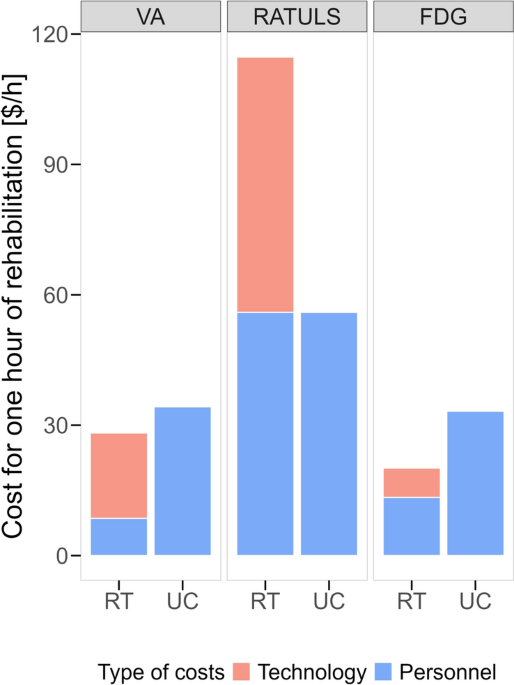
This analysis compares the three largest Randomized Control Trial (RCT) studies in the field of upper limb robotic rehabilitation of stroke patients, that also include an economic evaluation. The authors, who were involved in varying degrees and capacities with the original studies, evaluated the efficacy and costs of the different organizational models, described in the original studies, compared to usual care treatments8,9,10,17,20,31. The original studies were carried out in accordance with relevant guidelines and regulations, as described in details in the respective papers9,10,32. All the experimental protocols of the original studies were approved by relevant institutional bodies: the Veteran Affairs (VA) Robotics study protocol was approved by the institutional review boards at each participating site and the human rights committee at the coordinating center (VA Cooperative Studies Program Human Rights Committee, West Haven, CT); approval for the RATULS study protocol was granted by the National Research Ethics Committee Sunderland (reference 12/NE/0274); finally the institutional Ethics and Experimental Research Committee of the Fondazione Don Carlo Gnocchi (FDG) approved the study protocol of the FDG multicenter clinical trial on April 6th, 2016 (FDG_6.4.2016). Written informed consent was obtained from all subjects involved in the respective clinical trials.
Description of the three organizational models
VA-Robotics
Four Department of VA medical centers were equipped with three modules of the MIT-Manus robot, designed to train movements of the shoulder, elbow, wrist, and hand21,33. The clinical protocol involved sessions of one hour over a period of 12 weeks delivered to outpatients32. In usual care there was a 1:1 therapist-to-patient ratio where a single therapist treated a single patient for 60 min. In the upper limb rehabilitation robotic program, a therapist supervised the patient for 15 min out of the 60-min treatment session. The other 45 min were devoted to other productive robotic assisted tasks or activities. This is equivalent to a single therapist supervising 4 patients in a treatment slot of 1 h (1:4 therapist-patients ratio). The “base case” described in the paper20 employs 2 patients per slot and foresees 43 slots of robotic therapy per week and 50 weeks of robotic gym usage per year. The resulting maximum number of robotic sessions that can be delivered per year is 4,300.
RATULS
In the RATULS study the robotic gyms were equipped with 2 MIT-Manus (InMotion commercial version) robotic devices. Treatments were predominantly delivered to outpatients in 1-h slots with a therapist supervising a single patient for the entire duration of treatment (1:1 therapist-patient ratio) both in robotic and usual care. The advantage of robotics, compared with conventional treatments, was expected in terms of better clinical outcomes. The base case described in the paper31 foresees 35 slots of rehabilitation robotic treatment per week, 1 patient per slot, and 52 weeks of robotic gym usage per year. The resulting maximum number of robotic sessions that can be delivered per year is 1,820.
FDG
The FDG rehabilitation center “Santa Maria della Provvidenza” (SMP) – based in Rome, Italy – is equipped with 4 devices: the Motore (Humanware – Italy) and 3 Tyromotion devices (Amadeo, Diego and Pablo, Tyromotion – Austria). The suite of 4 devices, which were selected through a structured Health Technology Assessment procedure34, can provide a comprehensive rehabilitation of the upper limb. The clinical protocol adopted by FDG foresees treatment sessions of 45 min. In the SMP rehabilitation center of FDG, treatments are delivered to patients in three different care settings: inpatient, day hospital and outpatient, accounting for an average of 56.4%, 34.3% and 9.3% of the total rehabilitation services provided respectively17. Patients treated in the inpatient setting require an assistant to transport them from their hospital bed to the robotic gym. In addition, approximately half of the day hospital patients require an assistant for transportation to their robotic therapy session. Conventional therapy for inpatients is delivered at their bed and therefore an assistant for transportation is not needed.
Within a FDG session of robotic rehabilitation, a single therapist supervises 3 patients concurrently, each interacting individually with a single device (1:3 therapist-patient ratio). This is equivalent to a therapist supervising a patient for 15 min out of the 45-min session duration. In usual care, a single therapist treats a single patient for 45 min (1:1 ratio).
The maximum number of robotic therapy sessions that can be delivered per year using the FDG model is 8,250, determined as follows: 55 slots of robotic rehab treatment per week (10 per day from Monday to Friday and 5 on a Saturday), 3 patients per slot, and 50 weeks of robotic gym usage per year. Considering the treatment duration (45 min) this corresponds to a total of 6,187.5 h of annual robotic device availability.
Efficacy of robot-based interventions
The characteristics of the three studies are described in Table 1 while the main findings are reported in the following. Of notice the three studies employ different clinical scales except for the Fugl-Meyer Assessment (FMA). The Minimal Clinically Important Difference (MCID) for the FMA is 4.0 for patients with acute stroke35 and 5.25 for those with chronic stroke36.
VA-Robotics
Considering all the patients recruited during the 2-yearlong study, at 12 and 36 weeks, the mean FMA score for patients receiving robot-assisted therapy was better than that for patients receiving usual care (difference at 12-weeks, 4.2 points; [95% CI 1.3 to 7.1] and difference at 36-weeks, 4.6 points; [95% CI 0.6 to 8.6]) and the differences were significant and MCID (5.25) is within the 95% CI. The results on the SIS were significantly better for patients receiving robot-assisted therapy than for those receiving usual care at 12-weeks but not at 36-weeks (difference at 12-weeks, 8.3 points; [95% CI 2.7 to 14.0] and difference at 36-weeks, 3.2 points; [95% CI –2.9 to 9.4]). The results on the Wolf Motor Function Test (WMFT) were significantly better for patients receiving robot-assisted therapy than for those receiving usual care at 12-weeks but not at 36-weeks (difference at 12-weeks, 7.6 s; 95% CI, 0.1 to 15.1 and difference at 36-weeks, 7.8 s; 95% CI, − 0.05 to 15.7)11.
RATULS
The primary outcome was the Action Research Arm Test (ARAT) success at 3 months. The definition of success differed depending on baseline severity: baseline ARAT score 0–7 required an improvement of 3 points or more; baseline ARAT 8–13 required an improvement of 4 points or more; baseline ARAT 14–19 required an improvement of 5 points or more; baseline ARAT 20–39 required an improvement of 6 points or more. The results of the ARAT demonstrated that, at 3 months, the robot-assisted training group did not show significant differences compared to Enhanced Upper Limb Therapy and usual care. Nonetheless the results for the FMA motor subscale indicated a reduced upper limb impairment for the patients in the robot-assisted group compared with the usual care group both at 3 months (adjusted mean difference 2.79 [98.3% CI 0.66 to 5.01]) and 6 months (adjusted mean difference 2.54 [98.3% CI 0.07 to 5.06])10. Some of the secondary outcome comparisons indicated differences that are likely to be clinically important, since the MCID is within the 98.3% CI.
FDG multicenter clinical trial
The results indicated there was no significant difference in the change of FMA score between the robotic (mean improving: 8.50 points) and usual care groups (mean improving: 8.57 points) although both groups have exceeded the MCID (5.25). The Motricity Index (MI) showed a greater improvement for the robotic group when compared with the usual care group (mean difference 4.42 [95% CI 0.27 to 8.57]) at the completion of the rehabilitation program9.
As demonstrated by the clinical studies that have implemented the organizational models described in this paper, outcomes obtained with robotics rehabilitation are comparable with those of conventional treatments even for those models in which a single therapist supervises multiple patients.
Defining a common formula for comparing costs of rehabilitation robotics and usual care
After analyzing the three previously published studies, a common formula for computing costs sustained by the three healthcare settings for providing robotic and usual care rehabilitation has been computed. The cost components factored into the analysis included:
-
investment cost: the cost of the robotic devices purchased and the annual maintenance fees for the overall robot lifespan
-
personnel costs: the hourly cost of the therapist to conduct the treatments and other personnel (if needed) to transport patients from the hospital ward to the robotic gym. These hourly costs include all the employee-related expenses (e.g. benefits, social charges, insurance, etc.).
-
Overheads computed as a percentage of direct costs
-
Consumables costs (when needed).
The difference of costs between a robotic treatment (\(UC_RT\)) and a usual care treatment (\(RT_RT\)) is computed as follows:
$$\Delta Cost={C}_{RT} -{C}_{UC}=$$
$$=\left(\frac{{I}_{k}}{l\cdot {h}_{treats}}+{C}_{cons}+{C}_{th}\cdot \frac{{d}_{supervising}}{60}+{C}_{assistant}\cdot \frac{{d}_{assistan{t}_{RT}}}{60}\right)-\left({C}_{th}+{C}_{assistant}\cdot \frac{{d}_{assistan{t}_{UC}}}{60}\right)$$
(1)
where l is the robot life span, \({h}_{treats}\) is the sum of the hours of robotic devices usage in a year, \({C}_{cons}\) are the consumable costs, \({C}_{th}\) and \({C}_{assistant}\) are the therapist and assistant hourly cost (including overheads) respectively, \({d}_{supervising}\) is the time (expressed in minutes) spent by the therapist in supervising each patient during an hour of treatment, \({d}_{assistan{t}_{UC|RT}}\) is the time spent by the assistant to take UC or RT patients to the rehab gym, and finally Ik is the investment cost for the hospital k (k = VA, RATULS, FDG). The parameter \({d}_{supervising}\) can assume either discrete or continuous values depending on the organizational model adopted. In particular, if the center opts to allocate therapist time across multiple patients in a session, the parameter assumes specific discrete values (e.g., 15 min in case of 1:4 therapist-patients ratio). Conversely, if the center chooses to dedicate a portion of the therapist’s time to patient supervision and reassign the remaining time to other productive activities (as is the case for the VA organizational model), the parameter may be treated as a continuous variable.
The investment Ik is computed in different ways in the three studies: the FDG study (Italy) used a simple sum of financial costs incurred over the robots’ life span, in the RATULS study (UK) the Equivalent Annual Cost (EAC) has been used, the VA-Robotic study (US) used the Net Present Value (NPV) and added an interest rate to the purchase price. The three formulas used to compute the investment costs are reported below:
$${I}_{VA}={\sum }_{i=0}^{l-1}\frac{{C}_{i}}{{\left(1+{r}_{NPV}\right)}^{i}}={P}_{Robots}\cdot \left(1+\frac{O{H}_{\%}}{l}+{int}_{\%}\cdot l\right)+\left(M+{P}_{Robots}\cdot \frac{O{H}_{\%}}{l}\right)\cdot {\sum }_{i=1}^{l-1}\frac{1}{{\left(1+{r}_{NPV}\right)}^{i}}$$
(2)
$${I}_{RATULS}= \left({P}_{robots}+M\cdot l\right)\cdot A\cdot l \ {\rm where} \ A=\frac{{r}_{EAC}}{(1-\frac{1}{{\left(1+{r}_{EAC}\right)}^{l}})}=\frac{{r}_{EAC}{\left(1+{r}_{EAC}\right)}^{l}}{{\left(1+{r}_{EAC}\right)}^{l}-1}$$
(3)
$${I}_{FDG}={(P}_{robots}+ M\left(l-1\right))\cdot (1+O{H}_{\%})$$
(4)
The method used to compute the investment influences the effect that a change of the discount rate parameter has on the quantification of the investment costs. In the NPV, an increase in the discount rate reduces \(\Delta c\text{ost}\) in favor of robotics, while in the EAC, increasing the discount rate increases \(\Delta Cost\) in favor of usual care. For this reason, two separate parameters (\({r}_{NPV}\) and \({r}_{EAC}\)) have been considered in the cost formula.
The differential costs (\(\Delta Cost\)) for each study was initially computed using the methods reported in the respective papers and then re-calculated using the methodologies of the other two studies. This allowed to evaluate the influence of the methodology used to compute investment costs on the final value of \(\Delta Cost\) for each study.
The definitions for the different parameters used in the formulas above are explained in Table 2.
Methods for cost comparison
Given the difference in session duration (45 min for FDG and 60 min for VA and RATULS) we have normalized the costs for an hour of treatment. Moreover, all costs have been expressed in US dollars using the following currency exchange rates based on the averages of the Purchasing Power Parity values, indicated by the World Bank Group37, in the period between the first study (VA-Robotics, 2009) and the last study (FDG study, 2018): 1€ = 1.3627 $ and 1£ = 1.4353 $.
Initially the cost difference between robotic and usual care has been calculated by assigning to the parameter \({h}_{treats}\) the maximum total hours of robotic devices availability (\({h}_{treat{s}_{Max}}\)). This cost difference represents the maximum theorical difference that can be achieved if all the available slots of robotic treatments are filled. However, the actual number of robotic treatments delivered by the hospital will be lower than the available slots for several reasons, including the “availability” of patients (e.g., the number of patients referred to the clinic for rehabilitation may not be sufficient to fill all the slots), cultural barriers leading to a lower number of robotic treatments prescribed by clinicians, organizational inefficiencies, etc38. To take these constraints into consideration, we have introduced a new parameter (\(fil{l}_{\%}\)) that represents the percentage of available slots of robotic treatments that are actually filled (\({h}_{treats}={h}_{treat{s}_{Max}}\cdot fil{l}_{\%}\)). We have therefore represented the cost difference as a function of \(fil{l}_{\%}\), and we have identified what is the minimum percentage of slots that must be filled to obtain savings with robotic treatments (i.e., to have \(\Delta Cost<0\)).
Local sensitivity analysis
To evaluate the formula’s local sensitivity to its parameters, the Differential Importance Measure (DIM) method, proposed by Borgonovo and Apostolakis39 and previously applied in investment project evaluation40 was used. DIM is defined as follows:
$$DI{M}_{i}= \frac{\frac{\partial g\left({{\varvec{x}}}^{0}\right)}{\partial {x}_{i}}\cdot d{x}_{i}}{\sum_{j=1}^{n}\frac{\partial g\left({{\varvec{x}}}^{0}\right)}{\partial {x}_{j}}\cdot d{x}_{j}}$$
(5)
where \(g\left({\varvec{x}}\right)\) is the function of the formula under study (in our case \(\Delta Cost\)), \({\varvec{x}}=({x}_{1},{x}_{2},\dots {x}_{n})\) are the parameters of the formula and \({{\varvec{x}}}^{0}\) is the vector of the reference values of the parameters and \(d{x}_{i}\) is the “perturbation” of the \({i}^{th}\) parameter. In our case, the \({x}_{i}^{0}\) parameter values are derived from the original papers of the three studies17,20,31.
DIM allows for the evaluation of parameter changes under the assumption of proportional perturbations (i.e. variations in parameters as a percentage of their values). This approach enables comparison of the impact of formula parameters with different magnitudes and units of measurement. Differently from a one-way sensitivity analysis, the DIM allows to evaluate the relative impact on the differential cost (\(\Delta Cost)\) of each parameter, with respect to all the others.
Sustainability of robotic rehabilitation
The sustainability of robotic rehabilitation programs was evaluated by comparing the (additional or reduced) profit margins of robotic treatment to usual care. Four therapy reimbursement scenarios were identified based on 2 variables: the availability of additional reimbursement for using robotic devices, and the possibility of reimbursement for the entire treatment time when a therapist supervises multiple patients simultaneously (i.e. therapy time reimbursement vs. therapist time reimbursement).
The differential profit margin (\(\Delta M\)) was obtained as a function of the additional reimbursement for one-hour usage of robotic device (\({R}_{device}\)), the time reimbursed (\({T}_{reimb}\)), and the usual care reimbursement tariff (\({R}_{UC}\)) as follows:
$$\Delta M={M}_{RT}-{M}_{UC}=\left({R}_{RT}-{C}_{RT}\right)-\left({R}_{UC}-{C}_{UC}\right)=\left(\frac{{T}_{reimb}}{60}\cdot{R}_{UC}+{R}_{device}-{C}_{RT}\right)-\left({R}_{UC}-{C}_{UC}\right)$$
(6)
$$\Delta M={R}_{UC}\cdot \left(\frac{{T}_{reimb}}{60}-1\right)+{R}_{device}-\Delta Cost$$
(7)
The four considered reimbursement scenarios are the following:
-
1.
A special tariff for the use of robotic devices exists (on top of usual care reimbursement) and the reimbursement of therapy is based on the treatment duration (i.e., \({R}_{device}>0\) and \({T}_{reimb}=\) \(60\ min\))
-
2.
A special tariff for the use of robotic devices exists (on top of usual care reimbursement) and the reimbursement of therapy is based on the time spent by a therapist on one patient (i.e., \({R}_{device}>0\) and \({T}_{reimb}=\) \({d}_{supervising}\))
-
3.
There is no tariff for the use of robotic devices and the reimbursement of therapy is based on the treatment duration (i.e., \({R}_{device}=0\) and \({T}_{reimb}=\) \(60 \ min\))
-
4.
There is no tariff for the use of robotic devices and the reimbursement of therapy is based on the time spent by a therapist on one patient (i.e., \({R}_{device}=0\) and \({T}_{reimb}=\) \({d}_{supervising}\))
Calculations of \(\Delta M\) were performed under the assumption that the healthcare setting can fill all available robotic therapy slots (i.e. setting \(fil{l}_{\%}=100\%\)).
link