

How many times a day do you look down at your smartphone? Odds are, the number is pretty high — and every glance down and minute scanning the screen takes a toll on your neck.
Advertisement
Cleveland Clinic is a non-profit academic medical center. Advertising on our site helps support our mission. We do not endorse non-Cleveland Clinic products or services. Policy
This reality of modern-day life is the damaging force behind a repetitive-use injury known as “tech neck.”
So, how do we tackle this pain? We asked chiropractor Andrew Bang, DC, for guidance.
What is tech neck?
Tech neck syndrome (or “text neck syndrome”) is a … well, literal pain in the neck. The name colorfully describes the physical stress caused by tilting your head forward to gaze at a handheld smartphone or tablet.
Given the weight of your head, this positioning can stress and damage your neck, shoulders and back.
“Injuries start happening in your neck and all the muscles around there,” says Dr. Bang. “We see cervical disks in your spine degenerating because of that forward head posture.”
How tech neck happens
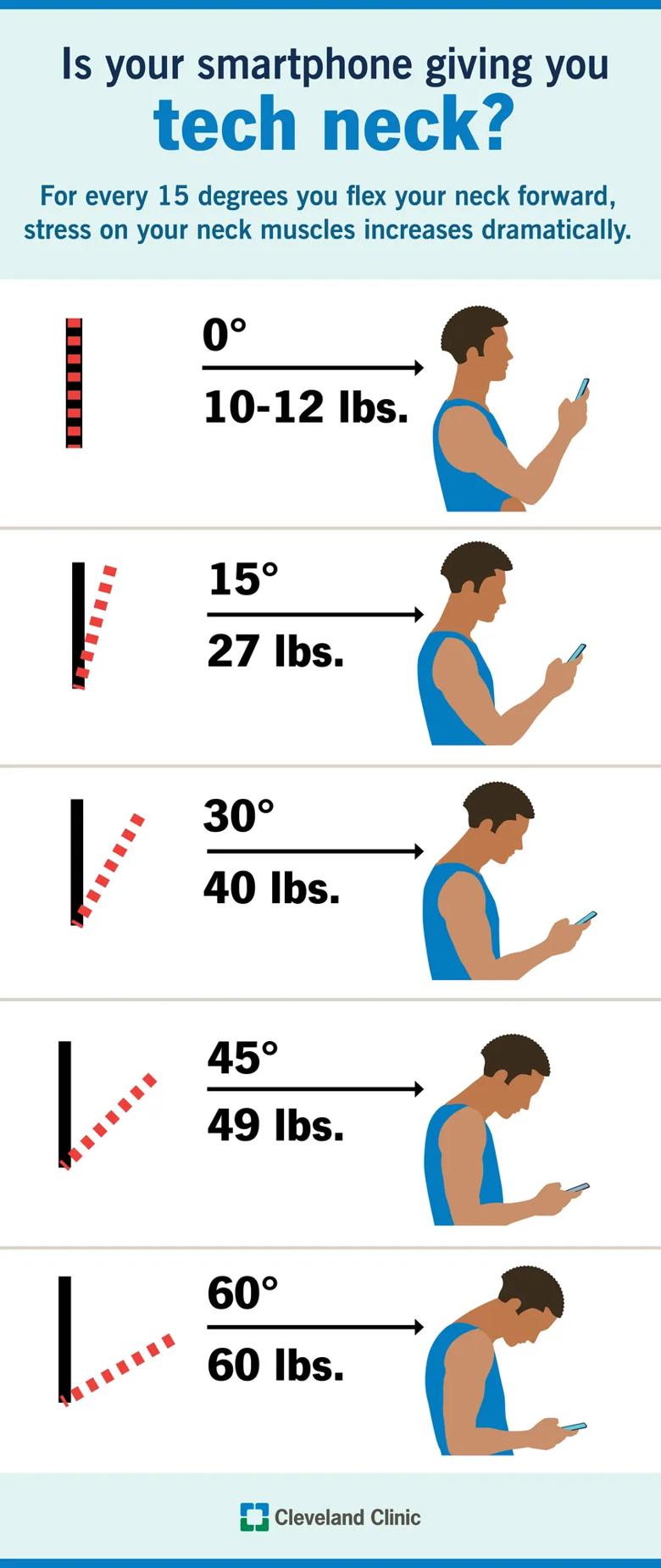
Think of your head like a 10- to 12-pound bowling ball. “Your neck muscles and the natural banana-like curve of your spine are designed to support that weight when they’re in a neutral position,” explains Dr. Bang. “But as you tilt your head forward, the load on your neck increases.”
The demands on your neck muscles increase significantly with every 15 degrees you flex your neck forward. To put that in perspective:
- With just a slight glance down, your head becomes the equivalent of a 27-pound weight.
- At a 30-degree neck tilt, your head feels like 40 pounds.
- Dip your head significantly forward to read a phone held near your lap and you may put upwards of 60 pounds of force on your neck.
At the same time, your shoulders round as you hunch forward to improve your view of the screen. This puts added pressure on your entire upper frame.
Put this all together and you’ve got a recipe for musculoskeletal misfortune.
Now, in the moment, you probably won’t feel the full effects of this poor posture. Glancing down for a few seconds here or there won’t cause much harm. Your body’s framework isn’t that fragile.
But we spend hours a day looking down at screens to read a text or watch funny pet videos. That takes a toll.
“Unfortunately, it’s kind of a cumulative effect,” says Dr. Bang. “If you’re scrolling for sustained periods of time day after day, that’s where the real problems come into play. The problems build.”
Tech neck symptoms
Stiffness, soreness or sharp pain in your neck and shoulders are signs that you’re spending too much time hunched over your phone. Over time, this sort of persistent strain can contribute to arthritis.
Tech neck may also cause symptoms like:
- Headaches and nausea
- Numbness and tingling in your arm, hand and fingers from nerve irritation
- Degenerative disk disease
- Fatigue, in part due to decreased lung capacity from being hunched over
Tech time may lead to other issues, too, like:
- Eye strain related to staring at a screen too long
- Finger and thumb pain from tapping and scrolling
- Elbow aches from holding devices in a fixed position for long periods
Tips to prevent tech neck
Giving up handheld electronic devices entirely would certainly help limit this problem, but that’s probably not realistic in today’s world. So, what are your other options? Dr. Bang has a few simple suggestions to stop tech neck.
- Change your view. Raising your device closer to eye level eliminates the need to tilt your chin down. “Try to keep your head in a position where you’re looking straightforward,” suggests Dr. Bang.
- Aim for variety. Remaining stuck in any one pose for more than 20 minutes at a time can bring aches. “Change your position regularly, even if that just means moving your phone from hand to hand,” advises Dr. Bang. “The best posture is a moving posture.”
- Take breaks. It’s easy to get sucked into the online world. (How can you not click on that video, right?) But be mindful of how long you’re on a handheld device and try to limit sessions to no more than 15 to 30 minutes.
- Go hands-free. If you’re in a meeting or on a long call, set your phone on a stand set to eye level instead of holding it down. Using the speaker or headphones can help, too.
How to treat tech neck
If you’re already feeling the effects of tech neck, try these tactics in addition to the preventative steps shared above.
- Stretch regularly. Motion is lotion, says Dr. Bang, so try to regularly move your head and neck to loosen up tight muscles while sitting at a desk or on the couch. Don’t forget your shoulders and back, too.
- Use hot or cold therapy. A warm compress on your neck may help ease tight muscles. Cold therapy, meanwhile, can reduce inflammation and dial down biting pain.
- See a specialist. Hands-on chiropractic or massage therapy may help you work out any kinks in your neck. A physical therapist, osteopathic physician, acupuncturist or other healthcare professional may also be able to suggest strengthening exercises to help.
- Take a pain reliever. Over-the-counter medications may offer some in-the-moment relief. But remember that they’re not a long-term solution and aren’t safe for everybody.
Final thoughts
The next time your neck feels a bit creaky, think about how you spent your day. Self-awareness of your tech routine may be the first step in addressing the issue.
“Making a few simple changes in how you hold and look at your phone or tablet can make a huge difference in how you feel,” emphasizes Dr. Bang. “Sometimes, it really can be just that simple.”
link